Philadelphia supports healthcare, education, legal, finance, life-sciences and corporate operations, while Pittsburgh combines healthcare, technology, energy, education and advanced manufacturing. Harrisburg adds state government, and the Lehigh Valley, Erie, Scranton–Wilkes-Barre, Lancaster and other regions bring logistics, manufacturing and local services. A statewide office network cannot be evaluated from one metro’s assumptions.
Begin a Pennsylvania office copier price comparison with one data sheet per location, then use shared security, driver and reporting standards where they create operational value.
Compare Philadelphia and Pittsburgh copier workflows independently
A Philadelphia legal or life-sciences office may require secure scanning and complex client packets. A Pittsburgh healthcare, university or engineering team may emphasize protected records, technical documents and high-capacity capture. Observe the jobs rather than assuming similar employment counts produce similar needs.
Use the copier feature guide for paper, feeder, OCR, finishing and software. Ask the provider to identify the exact configuration and demonstrate critical workflows.
Create a Pennsylvania copier fleet that respects branch size
Common device families can simplify drivers, user training, supplies and security. Hardware capacity should still follow site meters and peak queues. Determine the right copier size and do not place headquarters equipment in a small branch for contract convenience.
A managed print services assessment should reconcile direct printers, lease dates and service history. Require reasons for every replacement and make sure consolidation does not create a single point of failure for critical documents.
Use one copier security baseline across Pennsylvania offices
Healthcare, education, government, legal and financial organizations should define authentication, secure release, encryption, firmware administration and drive sanitization. The copier security guide provides a common evaluation list.
Ask who configures each location and whether software licenses are priced for all users. A policy is effective only when the installed devices are configured, documented and reviewed.
Separate Pennsylvania copier lease terms from regional service
Use the copier lease-versus-buy comparison to evaluate finance, ownership and return. Then ask dealer-specific questions about technician bases, parts, response and escalation in every market.
Review page allowances, toner, labor, parts, travel and annual increases with the service contract guide. The finance obligation may remain even if service is performed by a separate company.
Price Pennsylvania copier delivery and recovery by exact building and route
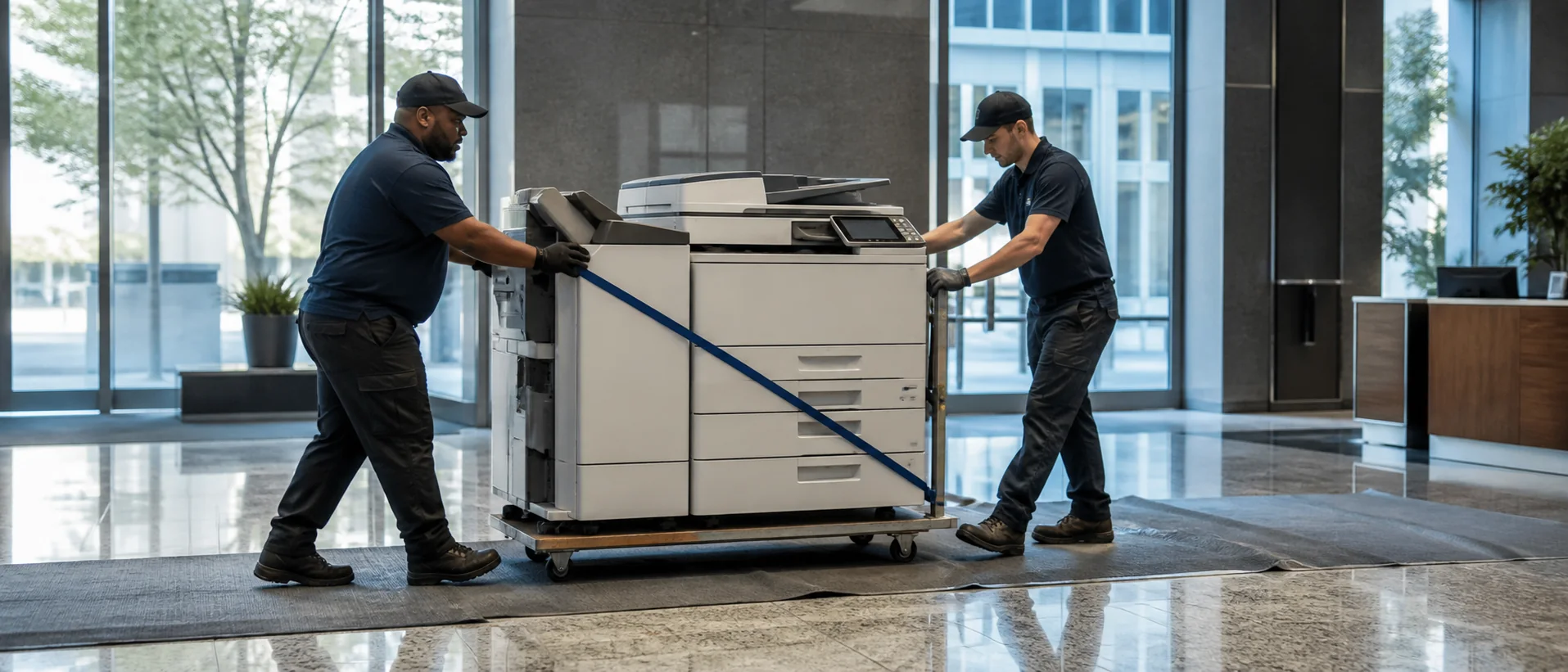
List each Philadelphia, Pittsburgh, Harrisburg, Lehigh Valley, Erie and regional address with its delivery entrance, stairs or freight elevator, security requirements and service window. A statewide dealer may use different technicians, parts depots and escalation paths across that footprint. General coverage language should become a written site schedule.
Define restored operation for every critical machine: required paper, authenticated release, document capture and connection to the correct business repository. If an alternate device is in another building, confirm that users can reach it and preserve protected records without an uncontrolled transfer.
Review first response, repeat calls, parts delays and complete downtime by serial number. Pennsylvania fleet averages should not conceal a location whose historic building, travel route or specialized workflow repeatedly extends recovery. Use those results to revise placements, spare capacity and contract terms before renewal.
Compare Pennsylvania copier brands through one controlled request
Use the complete copier quote checklist and request equivalent Canon, Xerox, Ricoh, Sharp and Konica Minolta systems. Submit a Pennsylvania copier pricing request with every service location listed.
Compare region-specific equipment inside one accountable fleet plan.
Keep workload, security and service assumptions visible in every proposal.