Fargo has the state’s largest concentration of healthcare, education, technology, finance and professional services. Bismarck adds government and healthcare, while Grand Forks, Minot, Dickinson, Williston and regional communities support energy, agriculture, military-adjacent and local business. The distance between locations changes the practical value of dealer service.
A responsible North Dakota office copier price includes freight, installation, toner fulfillment, technician coverage and parts—not only the equipment payment.
Plan North Dakota copier delivery and setup before shipment
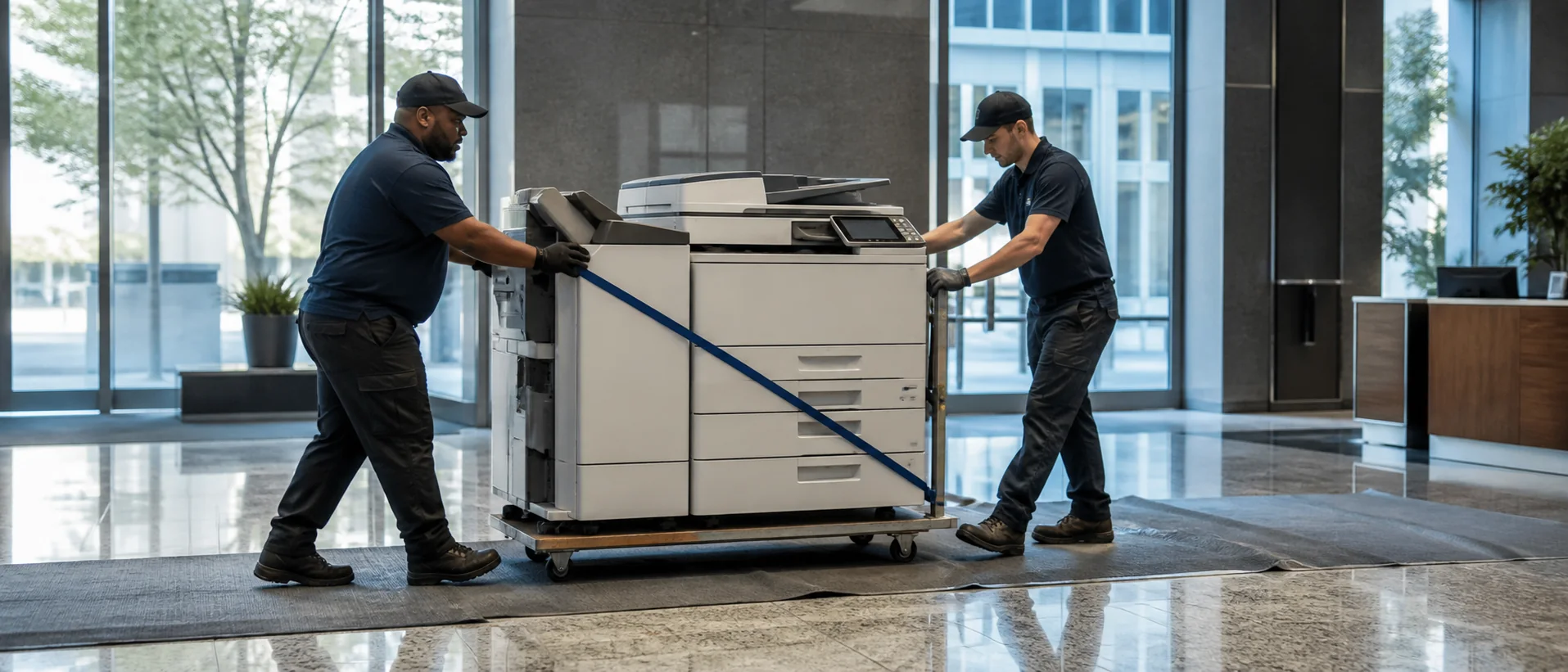
Confirm building access, stairs, elevator, electrical service, network availability and the internal delivery route. The proposal should state who coordinates freight, installs accessories, configures scanning and trains employees. Use the copier quote checklist so implementation is not left to verbal assumptions.
For a remote or lightly staffed site, schedule the customer’s IT contact and decision maker for installation day. Testing print and scan workflows before the installer leaves prevents a service call for incomplete setup.
Choose a North Dakota copier that handles real seasonal peaks
Agriculture, energy, education and government work can create deadline-driven periods that monthly averages obscure. Record the busiest month and largest repeating job, then select an appropriate copier size.
Do not run ordinary demand near the machine’s maximum duty cycle. Adequate paper, feeder capacity and a proven local service history can provide more resilience than buying unnecessary advanced finishing.
Make North Dakota service and supply lead times explicit
Ask where technicians and parts are based, how calls are prioritized and what happens when weather or distance delays travel. A remote diagnostic step can shorten recovery, but it does not replace a field plan for hardware failure.
Review copier maintenance coverage for travel, labor, parts, toner and exclusions. Agree on a sensible spare-toner policy and the meter threshold that triggers replenishment.
Evaluate North Dakota copier leases, purchases and used equipment for support risk
Leasing can schedule replacement and conserve cash; ownership can reward long use at stable sites. Compare both with the copier lease-or-buy guide and include return freight in any lease-end calculation.
For refurbished equipment, verify meter history, installed options, firmware status and service eligibility for the exact model. Low acquisition cost does not compensate for difficult parts or unsupported software.
Accept North Dakota copier equipment after cold freight and workflow testing
Schedule delivery through a protected route and let cold equipment, paper and toner stabilize in conditioned space before opening or powering them. Verify doors, thresholds, elevators, power, network position and technician clearance during the survey. The installed-price schedule should identify special freight, inside delivery, assembly and removal.
Run a representative packet only after the machine and supplies are stable. Have an ordinary employee release confidential output and scan mixed pages to the approved repository, then inspect the final file for order, legibility, naming and access. Keep the successful configuration outside the device for later repair or replacement.
For an office beyond the largest service hubs, document the authenticated alternate machine, local supply reserve and escalation path. The copier maintenance agreement should distinguish call acknowledgement, safe technician arrival, temporary operation and complete restoration.
Review meters, supply delays and downtime by address before renewal. One Fargo response average should not conceal the service experience of a Minot, Dickinson or Williston office.
Send providers one complete North Dakota copier requirement
Describe users, documents, peak volume, scan destinations, delivery and uptime needs. Review additional questions in the office copier answer library, then submit a North Dakota copier pricing request and compare each provider’s support path alongside the device.
Compare the delivered system and its recovery plan.
Use the same location, peak volume and support expectations for every quote.