New York City combines finance, law, healthcare, education, media, technology, fashion, hospitality, government and international business in one unusually varied office market. A Midtown advisory firm, Brooklyn medical practice, Queens logistics office and Bronx nonprofit may all request a color multifunction copier, yet their security, delivery and uptime requirements can be entirely different.
A useful New York office copier price comparison starts with the work and the address. Record monthly meters, peak queues, scan destinations, confidential documents, paper sizes, floor access and the business consequence of a service interruption before asking dealers to recommend equipment.
Match a New York office copier to the actual department workflow
Professional and financial offices often need searchable contract packets, secure client output and dependable proposal finishing. Healthcare and public-service teams may prioritize authentication, auditability and accurate scanning. Media, design and real estate groups can care more about controlled color and mixed paper. Build the requirement with the office copier feature checklist, then demonstrate a representative job on the exact proposed configuration.
Do not let a long software list replace a working test. Name the repository, identity platform, file convention and employee responsible for each scan route. If the connector carries a separate license or support agreement, it belongs in the proposal.
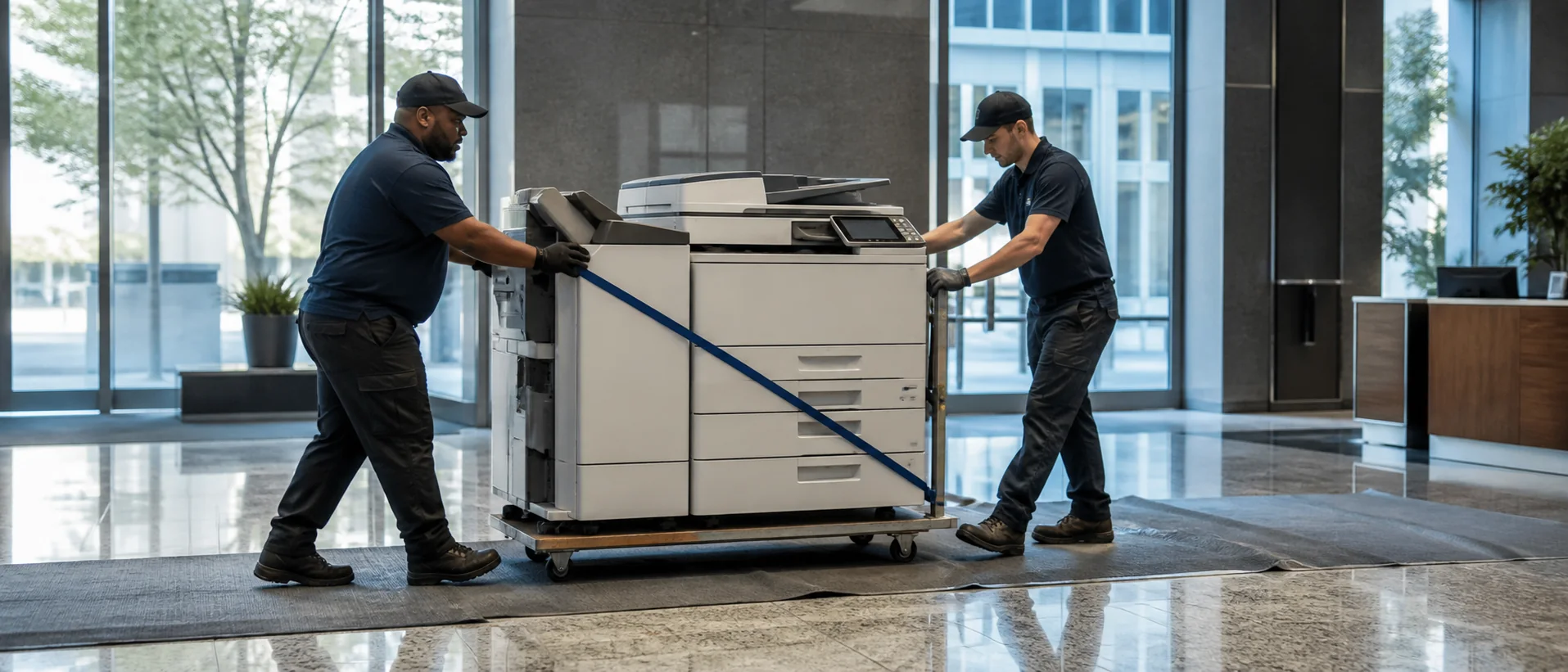
Plan New York City copier delivery around the building—not after the order
Commercial towers, converted lofts, medical buildings and neighborhood offices impose different freight-elevator, loading-dock, certificate-of-insurance and delivery-hour rules. Measure doors, elevator capacity and the final installed footprint with trays and finisher attached. Ask whether stair carry, union labor, after-hours access or old-equipment removal changes the price.
The complete copier quote checklist should itemize inside delivery, electrical requirements, network setup, driver deployment, user testing and training. A low machine price can disappear quickly when building logistics are left outside the written scope.
Specify copier security for New York financial, legal and healthcare records
Define user authentication, secure print release, administrator roles, encryption, firmware practice, address-book permissions and end-of-life storage sanitization. Review the copier security requirements with IT or compliance staff and require the provider to identify which controls are included, licensed and enabled.
Convenience still matters. Test badge, PIN or directory sign-in with real users and design simple role-based shortcuts. Security that employees cannot use consistently can create abandoned documents, shadow workflows and support calls.
Right-size New York copier fleets for hybrid occupancy and expensive floor space
Historic volume may overstate current demand in a hybrid office, while concentrated in-office days can create sharper queues. Collect device-level meters, active users and peak-day behavior before using the copier sizing guide. Compare one central A3 system with smaller A4 devices only after mapping walking distance, confidential output and the work each department cannot delay.
Organizations with several floors or borough locations may benefit from managed print services when monitoring, supplies, security policy and help-desk ownership are clearly defined. The goal is not automatically fewer machines; it is a fleet whose placement and capacity match how people work now.
Compare New York copier dealers by borough coverage and recovery evidence
Ask where the technicians assigned to the account begin their routes, which parts are stocked locally and how an urgent Manhattan call differs from service in Brooklyn, Queens, the Bronx or Staten Island. Review labor, toner, parts, page allowances, travel and annual increases through the copier maintenance contract guide.
A response target is only the beginning. Require a named escalation path for repeat failures, a plan for an ordered part and written expectations for loaner or replacement equipment when an essential department cannot operate.
Read New York copier lease terms with relocation and office change in mind
Leasing can preserve capital and coordinate refresh timing; buying can suit a stable configuration held beyond a typical finance term. Use the copier lease-versus-buy comparison to evaluate total payments, ownership, annual service increases, renewal notice and end-of-term return costs.
New York tenants should also review relocation, assignment and early-termination language. A company that changes floors, subleases space or combines offices needs to know whether the copier agreement can follow the business without surprise freight or payoff charges.
Evaluate copier brands through the New York provider that will configure them
Review current Canon office copiers, Xerox multifunction printers, Ricoh copier systems, Sharp business copiers and Konica Minolta bizhub models against one controlled workload. Then judge the dealer’s implementation team, technician familiarity and parts position for the specific family.
The best-known logo does not cure weak setup or slow local escalation. Ask every provider to explain why its proposed configuration fits the documents, building and user population rather than presenting an unrelated monthly payment.
Request comparable office copier proposals for a New York location
Use the broader New York State copier guide for multi-market planning. Then submit a New York City copier pricing request that gives each dealer the same site, volume, paper, scanning, security, installation and service standard.
Compare complete document systems for one exact New York workplace.
Price the equipment, building delivery, implementation and borough-level service together.