Northern New Jersey supports finance, healthcare, logistics, life sciences, legal and corporate operations closely tied to New York. Central business corridors add technology, distribution, education and professional services, while South Jersey connects to the Philadelphia market and a separate network of healthcare, manufacturing and local offices. Short geographic distance does not mean identical workload.
Organizations seeking New Jersey office copier prices should use one requirement format across sites while recording each location’s own pages, scans, users, access and downtime risk.
Use New Jersey office density to improve copier placement
Large workgroups and multi-floor offices can create queues even when total monthly volume appears moderate. Map users, walking distance, peak jobs and confidential output before consolidating devices. One larger machine may lower unit costs but create operational risk if departments lose access during service.
Determine the correct copier size and useful print speed from concurrency as well as monthly pages. A balanced deployment may use a departmental A3 system plus secure A4 devices near specialized teams.
Connect New Jersey multifunction printers to security and records systems
Life-sciences, healthcare, finance and legal organizations should define authentication, secure release, encryption, firmware practice and drive sanitization. Scanning requirements should identify repositories, file formats, OCR and access permissions. Review the copier security guide before comparing models.
Require the dealer, internal IT team and any managed provider to agree on implementation ownership. Network discovery, address books and default settings should be documented rather than rebuilt from memory after a device change.
Manage a New Jersey copier fleet without hiding local performance
A managed print services program can align toner, meter collection, security and lease dates across nearby offices. Reporting should remain granular enough to reveal high color use, repeated service and underused devices at a particular branch.
Ask why each device is retained, moved, replaced or removed. Consolidation must preserve employee access and continuity, especially where one machine serves revenue, patient or shipment documents.
Compare New Jersey copier leasing and maintenance as separate decisions
Use the copier lease-versus-buy guide to compare ownership, finance cost, upgrade timing and lease-end return. Then use the service agreement checklist for labor, parts, page allowances and escalation.
Ask whether the finance term and maintenance term end together, how annual increases are applied and which notice prevents automatic renewal. Place those dates in a procurement calendar rather than relying on a reminder from the seller.
Test New Jersey copier delivery and regulated records at the exact property
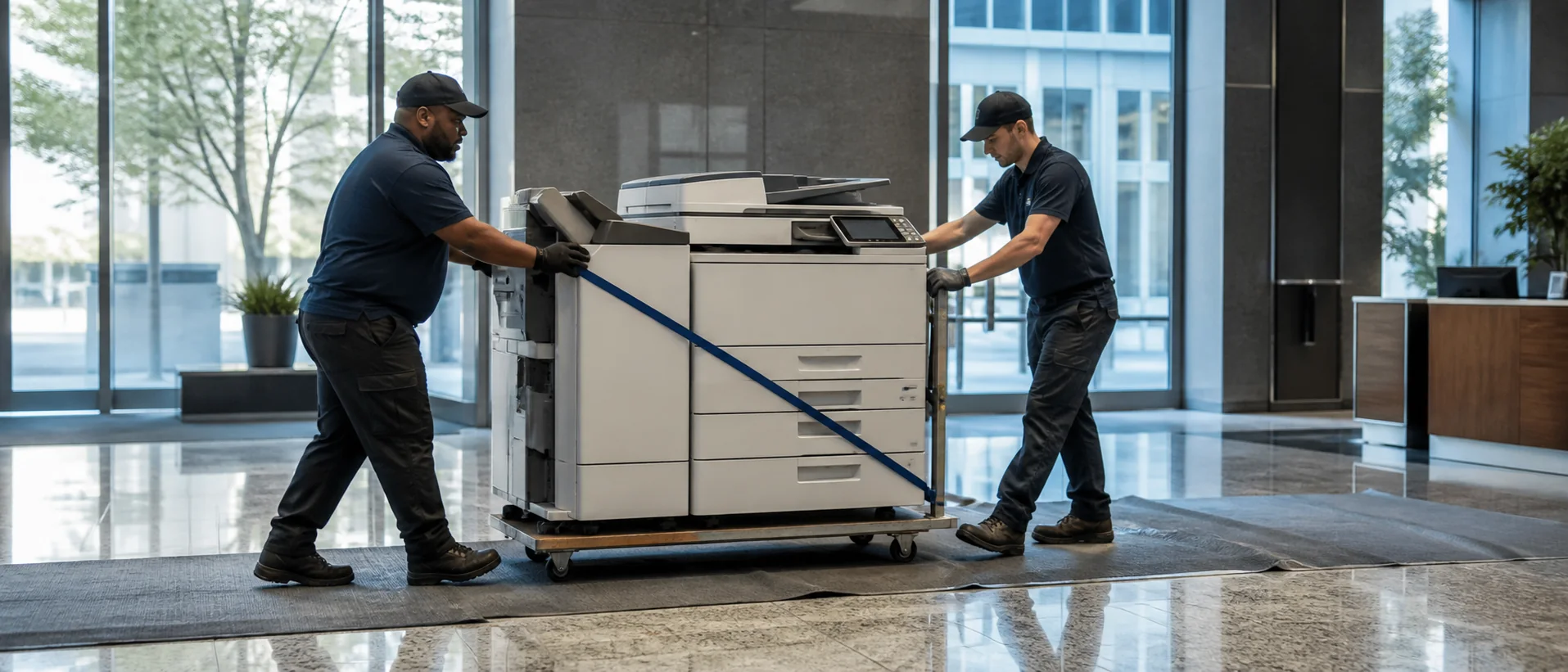
Dense office markets can hide materially different loading, elevator, security and service-window conditions. Walk the route from receiving area to final placement, verify power, network and technician clearance, and itemize property fees, assembly, after-hours work and removal.
For healthcare, finance, legal, pharmaceutical and public documents, have ordinary users scan a representative non-sensitive packet to the real repository. Inspect the completed file for order, legibility, naming, searchable text and permissions. Record the business owner for each shared route.
Maintain a site schedule for northern, central and southern New Jersey locations with assigned technicians, compatible backups and restoration expectations. Geographic proximity should not replace evidence of model expertise and complete workflow recovery.
Compare New Jersey copier dealers on exact configuration and implementation
Follow the complete copier quote checklist and ask for equivalent Canon, Xerox, Ricoh, Sharp and Konica Minolta systems. A detailed New Jersey copier pricing request should name locations, workflows and expected service before dealers choose equipment.
Turn office density into better placement and faster support.
Compare site-level needs within one controlled statewide requirement.