Troy’s commercial base combines automotive and mobility engineering, light manufacturing, corporate offices, professional services, healthcare, retail and hospitality. The city’s own property reporting shows industrial and light-manufacturing parcels as its largest commercial category, followed by substantial office, retail, medical and engineering uses.
An effective Troy office copier price comparison begins with the documents employees actually release, revise, scan and retrieve. That evidence should follow every provider from configuration through installation acceptance.
Preserve Troy automotive engineering revisions from feeder to archive
Mobility suppliers and technical offices may handle marked drawings, test reports, change notices, supplier certifications and controlled work instructions. Run creased originals, pencil annotations and mixed page sizes through the proposed feeder, then inspect the stored version at normal viewing scale.
The office copier feature checklist helps translate revision control, searchable capture and route naming into a defensible configuration.
Match Troy headquarters copiers to board, finance and client work
Corporate and professional teams may assemble contracts, financial packages, presentations, training sets and customer proposals under fixed calendars. Demonstrate complete jobs with tabs, mixed media and finishing rather than timing a blank diagnostic page.
Verify that authorized users can find the final digital record without renaming files by hand. An apparently fast copier still wastes time if authentication, conversion or filing interrupts every job.
Validate Troy medical packet scanning under everyday permissions
Clinics and medical offices should test identification, referrals, consents and long two-sided forms with non-sensitive representative documents. Confirm every side, orientation and patient identifier at the permitted destination, then interrupt one batch to observe recovery.
Use the copier security requirements for named access, held printing, encrypted storage, logs, remote support and end-of-life data removal.
Size Troy office copiers around project gates and concurrent users
Collect printed pages, scanned sides, active users, longest packets and immovable deadlines by department. Engineering releases, month-end reporting and enrollment work deserve separate peak measurements instead of being buried inside one monthly average.
Apply the commercial copier sizing framework to feeder duty, paper reserves, processor demand and simultaneous access. Capacity should fit the busiest repeatable hour.
Choose Troy A3 and color capacity for recurring technical communication
Wide diagrams, spreadsheets or proof sheets can justify 11-by-17 output, but occasional large pages do not require an A3 machine in every workgroup. Use the A3 versus A4 copier comparison to place shared capacity where it shortens real work.
Set controlled color defaults for customer presentations and technical markup after reviewing the color copier decision guide.
Survey Troy industrial sites, office towers and retail centers before delivery
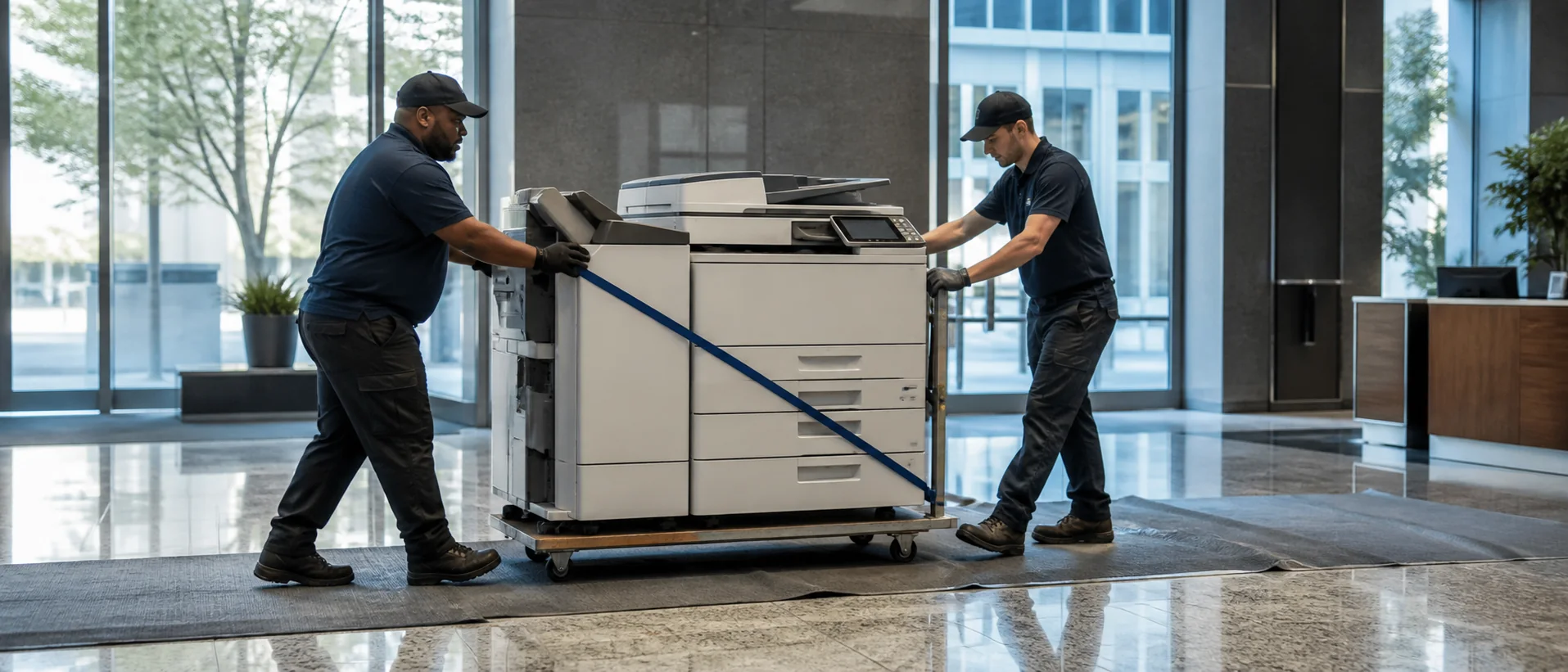
Document gates, dock appointments, security desks, freight elevators, doors, turns, floor protection and the final maintenance envelope. Confirm power, network position, ventilation and dry supply storage at the exact installation point.
Property managers may require insurance certificates or restricted receiving windows. Give the approved access record to both the installation crew and future service dispatch so a preventable site delay does not become downtime.
Prepare Troy copier continuity for winter access and supply delays
Keep sensible toner and paper reserves in conditioned space, identify the alternate device for fixed deadlines and document snow-cleared receiving access. Paper moved directly from a cold vehicle can absorb moisture as it acclimates, so delivery and storage procedures matter.
Separate remote diagnosis from onsite recovery commitments. A service promise should state how an urgent engineering or medical route is restored when travel conditions limit technician arrival.
Use Troy managed print evidence across corporate and technical locations
A managed print services assessment can expose unsupported printers, scattered supply purchasing and devices kept only from habit. Require meter, incident, cost and business-purpose evidence for every proposed removal.
Retain local capacity when a secured team, separate building, engineering deadline or customer counter makes document movement impractical. Consolidation should reduce waste without creating queues or weakening fallback coverage.
Define Troy copier service by application recovery, not technician arrival
Identify the dealer team trained on the proposed series, common parts stocked in the territory and ownership of authentication or repository failures. Read the copier service contract guide for impressions, consumables, labor, components, travel and software assistance.
Measure recovery as the return of a required engineering, client or clinical process. A machine that powers on but cannot reach the approved destination is not fully restored.
Compare Troy copier lease and purchase costs through the full obligation
Use the copier lease-versus-buy analysis to model equipment, workflow licenses, maintenance adjustments, insurance, office moves, extension payments and return transportation. Compare equivalent Konica Minolta copiers and Canon office systems against the same accepted files.
Keep optional finishers and applications itemized so decision makers can see which cost supports a documented job.
Request Troy copier prices with configuration and acceptance evidence
Normalize proposals with the complete copier quote checklist and the Michigan office copier guide. Require exact hardware, applications, delivery work, serving organization and pass-or-fail tests.
Submit a Troy copier pricing request with sample documents, peak calendars, user roles, property access and process-level recovery criteria.
Compare engineering accuracy, corporate workflow and accountable Metro Detroit support.
Price Troy copier systems around real documents, properties and recovery standards.